How Antibiotics Affect STD Test Results: What You Need to Know Before Testing
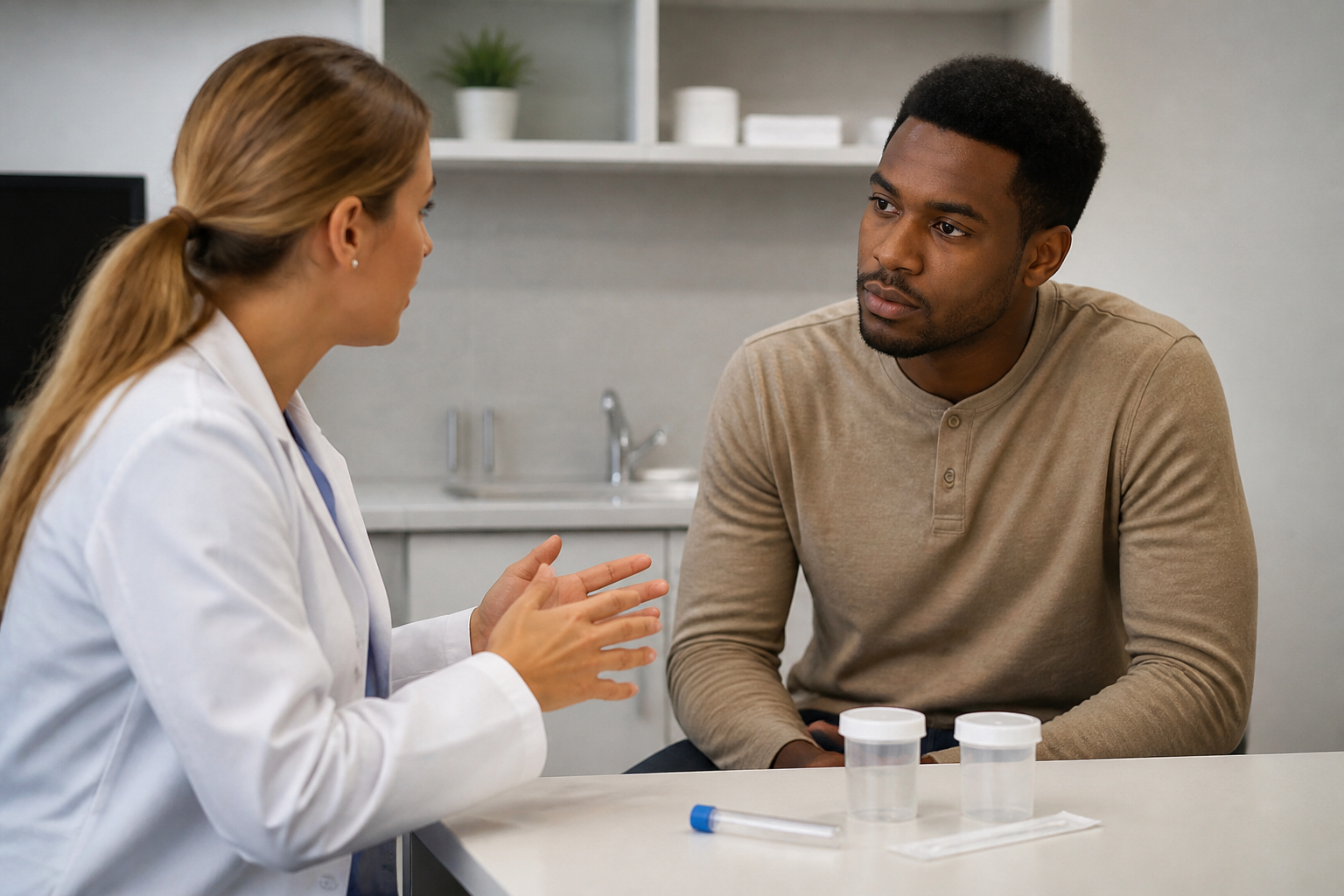
Antibiotics do not automatically make every STD test inaccurate, but they can affect interpretation depending on the infection, test method, specimen site, and timing.
Key takeaways
- Antibiotics may affect some bacterial STI testing situations, but they do not automatically make every result inaccurate.
- There is no universal number of days to wait after antibiotics before testing.
- Tell the healthcare professional or laboratory the antibiotic name, dose, timing, and reason for use.
- A negative result obtained during or soon after treatment may require clinical context, especially if symptoms or exposure concerns continue.
- Testing for initial diagnosis is different from testing after treatment to check whether an infection has cleared.
Yes, antibiotics can affect some STD test results or change how a result should be interpreted—but they do not automatically make every test inaccurate. The effect depends on the suspected infection, the antibiotic, the test method, the specimen site, and whether you are testing for an initial diagnosis or checking after treatment. There is no single waiting period that applies to every STI and every antibiotic.
Why antibiotics can matter
Antibiotics can reduce the number of viable bacteria at an infection site. This is particularly relevant to culture-based testing, which depends on living organisms being present in the specimen. However, not every STD test works by growing live organisms. Nucleic acid amplification tests, commonly called NAATs, detect genetic material, while syphilis testing relies on serologic testing and interpretation of antibodies and other test results.
Because tests work differently, it is not accurate to say that antibiotics always cause false-negative results or that NAATs are unaffected in every circumstance. A U.S. clinical study found that recent antibiotic use was associated with lower detected chlamydia prevalence in some groups, particularly with tetracycline use, but did not find the same association for detected gonorrhea. These findings support caution, not a universal false-negative rule.
Three testing situations to understand
1. Testing before starting antibiotics
When possible, testing before treatment may provide useful information about the infection and the appropriate follow-up. But you should not delay medically necessary care simply to test first. If antibiotics have already been prescribed, disclose that information when you seek testing. The clinician may consider your symptoms, exposure timing, anatomic sites of exposure, specimen type, and the test selected.
2. Testing while taking antibiotics
Testing during treatment can still be appropriate, especially when symptoms, a known exposure, or another clinical reason makes evaluation important. A negative result during treatment should not automatically be treated as proof that infection is absent in every situation. Antibiotic exposure, recent exposure, the site sampled, and the type of test can all affect how confidently the result answers the question.
Culture-based testing may be especially dependent on whether viable organisms remain in the specimen. For suspected gonorrhea treatment failure, the CDC recommends culture with antimicrobial-susceptibility testing because NAATs cannot provide susceptibility results. This is a clinician-directed situation rather than a reason to choose or repeat a test on your own.
3. Testing after treatment to check clearance
Testing after treatment is not interpreted the same way as initial diagnostic testing. Highly sensitive NAATs can detect residual genetic material from organisms that are no longer viable. That can produce a positive result that does not necessarily mean ongoing live infection.
- For chlamydia, the CDC advises against NAAT test-of-cure testing before four weeks after treatment in nonpregnant patients because residual nonviable organisms can cause false-positive results.
- For gonorrhea, pharyngeal test-of-cure testing at seven days may increase false-positive results; follow the timing and method directed by a healthcare professional.
- For trichomoniasis, the CDC advises that NAAT should not be performed before three weeks after treatment for retesting because residual nucleic acid may be detected.
These examples do not create a universal rule for all infections or all patients. The appropriate timing depends on the infection, treatment, test, specimen site, symptoms, pregnancy status when relevant, and reason for testing.
What about syphilis testing?
Syphilis diagnosis relies on combined treponemal and nontreponemal serologic testing, with interpretation based on clinical and testing context. Current CDC recommendations do not establish that routine antibiotics universally invalidate syphilis serology. An early infection can be an important reason for an initially negative result, so antibiotic use alone should not be used to interpret a syphilis test.
How to prepare for testing while taking antibiotics
- Write down the antibiotic name and dose if available.
- Note when you started it and, if completed, when you finished it.
- Explain why it was prescribed, such as another infection or a suspected STI.
- Describe current symptoms, when they began, and whether they are improving or continuing.
- Share the date and type of possible sexual exposure.
- Mention every exposed anatomic site, including the throat, rectum, genitals, or other areas, so the appropriate specimen can be considered.
- Ask how the result should be interpreted if testing occurs during or soon after treatment.
When a negative result may need follow-up
A negative result may need additional clinical follow-up when symptoms persist, the exposure was recent, the tested site did not match the exposure site, or testing occurred during or shortly after antimicrobial treatment. A single negative result should not be interpreted without considering those details. Do not use symptom improvement alone as proof that an STI was cured.
The bottom line
Antibiotics may influence the usefulness or interpretation of some STD tests, but they do not make every test inaccurate. The safest approach is to test when clinically indicated, disclose current and recent antibiotics, and follow professional guidance for any post-treatment test-of-cure. Avoid applying a fixed waiting period or assuming that a negative result automatically rules out infection.
Frequently asked questions
Can I take an STD test while taking antibiotics?
You may still need testing while taking antibiotics, especially after symptoms or a known exposure. Antibiotics can affect some testing situations, so disclose the medication and timing and ask how the result should be interpreted.
Can antibiotics cause a false-negative STD test?
They may reduce detectable bacteria in some circumstances, but evidence does not support a universal false-negative rule. The effect varies by infection, antibiotic, test method, specimen site, and timing.
How long should I wait after antibiotics before an STD test?
There is no universal waiting period for every STI, antibiotic, test, or clinical situation. Initial testing and post-treatment test-of-cure testing have different considerations.
Can an STD test be positive after antibiotics?
Yes. A highly sensitive NAAT may detect residual nucleic acid after treatment. For example, CDC guidance includes specific timing cautions for chlamydia, pharyngeal gonorrhea, and trichomoniasis retesting.
Should I stop antibiotics before an STD test?
No. Do not stop, skip, or delay prescribed medication to obtain a test. Tell the healthcare professional or laboratory what you are taking.
Sources & references
- Chlamydial Infections - STI Treatment Guidelines
- Gonococcal Infections Among Adolescents and Adults - STI Treatment Guidelines
- Trichomoniasis - STI Treatment Guidelines
- CDC Laboratory Recommendations for Syphilis Testing, United States, 2024
- Antibiotic Use before Chlamydia and Gonorrhea Genital and Extragenital Screening in the Sexually Transmitted Infection Clinical Setting
- Screening for Gonorrhea and Chlamydia: Systematic Review to Update the USPSTF Recommendations
- Sexually Transmitted Infections Treatment Guidelines, 2021
Sources are provided for general educational purposes only. This article is not medical advice. Consult a qualified healthcare professional with any health concerns.
Ready to compare testing options?
Use our independent, educational comparisons to understand your online STD/STI testing options.
View Provider Testing OptionsAffiliate link — we may earn a commission if you choose a provider through this link, at no extra cost to you. Pricing, turnaround and availability are set by the provider and can change.