STI Testing Samples: Urine, Blood and Swabs Explained
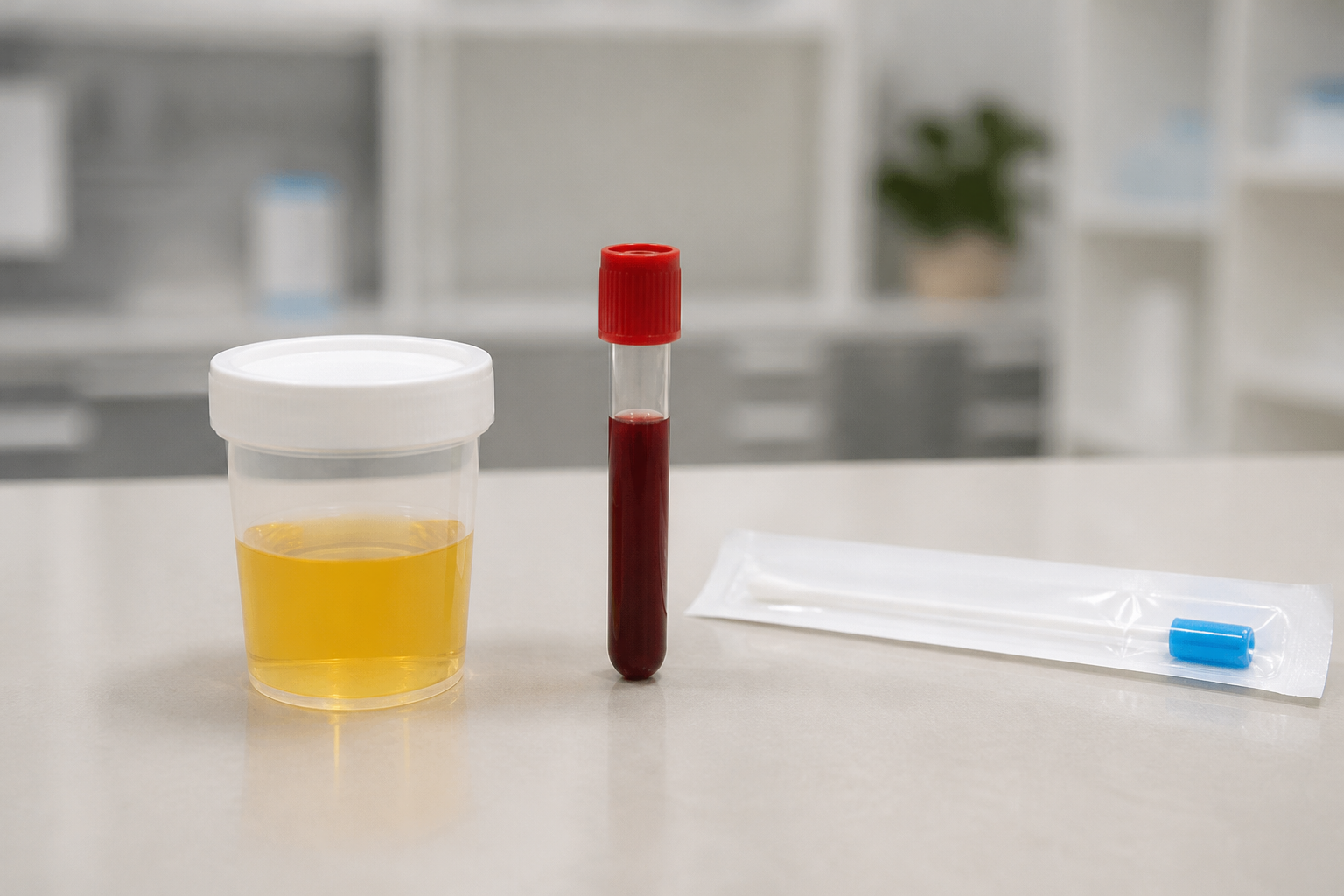
STI tests may use urine, blood, vaginal, throat, rectal, oral-fluid, or lesion samples. The right specimen depends on the infection, symptoms, and body sites exposed.
Key takeaways
- STI testing can use urine, blood, vaginal or urethral specimens, throat or rectal swabs, lesion swabs, and, for certain HIV tests, oral fluid.
- The best specimen depends on the infection being evaluated, symptoms, sexual practices, and the anatomic sites exposed.
- Urine-only testing may miss gonorrhea or chlamydia in the throat or rectum.
- A blood test is not a universal substitute for testing an exposed genital, throat, or rectal site.
- Test specimen requirements and FDA-cleared uses vary by assay and laboratory.
The short answer is that STI testing does not use one universal sample. Depending on the infection and the body site involved, a test may require urine, blood, a vaginal or urethral specimen, a throat or rectal swab, a swab from an active lesion, or oral fluid for certain FDA-authorized HIV tests. The correct choice depends on your sexual history, current practices, symptoms, the infection being evaluated, and the sites exposed.
Why the sample type matters
Many infections can occur at more than one anatomic site, and infections outside the genital or urinary tract may cause no symptoms. CDC guidance recommends considering testing at the sites reported as exposed. For gonorrhea and chlamydia, that can include urine or urethral testing after insertive genital exposure, rectal testing after receptive anal exposure, and pharyngeal testing after receptive oral exposure. A single sample from one location cannot automatically represent every other exposed location.
Urine and genital specimens
Urine is commonly used for testing certain urogenital infections, including many molecular tests for gonorrhea and chlamydia. Depending on the anatomy and the test, a clinician may instead collect a urethral or vaginal specimen. These samples are useful for the site collected, but they do not replace throat or rectal testing when those areas were exposed or when symptoms suggest involvement there.
Urine may also be used for some trichomoniasis tests. However, urine and vaginal specimens are not universally interchangeable. The performance of a specimen can depend on the assay and the population being tested, and FDA clearance varies. The laboratory or clinician should identify which specimen the specific test is designed to use.
Vaginal swabs
Vaginal swabs may be used for testing several vaginal infections, including some tests for trichomoniasis. Depending on the test, a specimen may be collected by a clinician or collected by the patient under the test's instructions. Collection methods and approved uses are assay-specific, so a vaginal swab intended for one condition should not be assumed to test for every STI.
Throat and rectal swabs
Throat and rectal swabs are examples of exposure-site testing. A throat swab may be considered after receptive oral exposure, while a rectal swab may be considered after receptive anal exposure. CDC notes that many pharyngeal and rectal gonorrhea and chlamydia infections are asymptomatic. Without testing the exposed site, a urogenital-only approach may miss an infection there.
- Genital or urethral exposure: urine or a genital or urethral specimen may be relevant for some tests.
- Receptive anal exposure: a rectal swab may be relevant for site-specific gonorrhea or chlamydia testing.
- Receptive oral exposure: a pharyngeal or throat swab may be relevant for site-specific testing.
- Multiple exposed sites: more than one specimen type may be needed, depending on the infections and assays being considered.
Blood and finger-stick samples
Blood or serum is central to serologic testing for infections such as syphilis. CDC guidance explains that syphilis diagnosis generally uses both nontreponemal and treponemal tests, which are typically performed on blood or serum. Some rapid tests use capillary whole blood, but those tests have specific roles and should not be treated as interchangeable with every laboratory-based test.
Blood testing is also used for certain HIV tests. The specimen, technology, and timing affect how results are interpreted. Blood testing should not be presented as a universal way to detect infections limited to the throat, rectum, or genitals.
Oral fluid for certain HIV tests
Oral fluid is different from saliva in the way people often use that word. The FDA-authorized OraQuick In-Home HIV Test collects oral fluid by swabbing the gums and is specific to HIV antibody testing. This example should not be generalized to other STIs or treated as equivalent to blood testing for every purpose.
Lesion swabs for herpes and other sores
When genital herpes lesions are present, CDC recommends collecting a specimen from the lesion for nucleic acid amplification testing or culture. A swab from an active lesion is different from a random or blind swab taken when no lesion is present. CDC states that random or blind swabs without lesions should not be used to rule out genital herpes. A negative result from an absent, old, or healing lesion does not automatically exclude infection.
A sore or ulcer should not be diagnosed by appearance alone. Symptoms can have multiple causes, and the appropriate evaluation may depend on the lesion's condition and the clinician's assessment.
How HPV testing differs
HPV testing for cervical cancer screening is a related but separate subject. It uses cervical cell samples and should not be described as a comprehensive test for HPV at every genital, oral, or anal site. A cervical screening test is not the same as a general site-specific STI test.
A practical way to discuss sample options
Before choosing a test, identify the body sites involved and whether there are symptoms. Consider genital, anal, and oral exposures separately rather than selecting a sample based only on convenience. Then ask which infections the assay evaluates, which specimen types it accepts, whether the use is intended for screening or diagnosis of symptoms, and whether the assay is FDA-cleared for that specimen and population.
- Which body sites were exposed during sex?
- Are there symptoms such as discharge, pain, a sore, rash, or bleeding?
- Which infections are being evaluated?
- Does the test accept the needed specimen type and body site?
- Is the specimen intended for screening, symptom evaluation, or follow-up?
- Does the laboratory or clinician explain what a negative, positive, indeterminate, or discordant result means?
The bottom line
STI testing sample types are chosen for a reason: the specimen should match the infection being evaluated and the body site that may be affected. Urine can be appropriate for some urogenital tests, blood is important for many serologic tests, swabs can evaluate vaginal, throat, rectal, urethral, or lesion sites, and oral fluid has a limited role in certain FDA-authorized HIV testing. No single sample checks for every STI at every location.
Frequently asked questions
Can a urine test check for all STIs?
No. Urine may be appropriate for some urogenital tests, but it does not automatically evaluate the throat, rectum, skin lesions, or every infection. The appropriate specimen depends on the infection, assay, symptoms, and exposure sites.
Do I need a throat or rectal swab after every sexual encounter?
Not necessarily. Testing decisions depend on the sexual practices and body sites exposed, the infection being evaluated, symptoms, and the available assay. CDC guidance supports site-specific testing when those sites were exposed.
What sample is usually used for syphilis testing?
Syphilis testing primarily relies on serologic testing, generally using blood or serum. Interpretation usually involves both nontreponemal and treponemal tests.
Can a herpes swab be collected without a sore?
CDC recommends lesion specimens for NAAT or culture when genital lesions are present and states that random or blind swabs without lesions should not be used to rule out genital herpes.
Is an oral-fluid HIV test the same as a saliva test for other STIs?
No. The FDA-authorized OraQuick In-Home HIV Test uses oral fluid collected by swabbing the gums and is specific to HIV antibody testing. That use should not be generalized to other STIs.
Is an HPV test the same as an STI test?
No. HPV testing for cervical cancer screening uses cervical cell samples and is distinct from general site-specific STI testing.
Sources & references
- Getting Tested for STIs
- Sexually Transmitted Infections Treatment Guidelines, 2021
- Syphilis - STI Treatment Guidelines
- CDC Laboratory Recommendations for Syphilis Testing, United States, 2024
- Herpes - STI Treatment Guidelines
- Trichomoniasis - STI Treatment Guidelines
- Information regarding the OraQuick In-Home HIV Test
- Cervical Cancer Screening
Sources are provided for general educational purposes only. This article is not medical advice. Consult a qualified healthcare professional with any health concerns.
Ready to compare testing options?
Use our independent, educational comparisons to understand your online STD/STI testing options.
View Provider Testing OptionsAffiliate link — we may earn a commission if you choose a provider through this link, at no extra cost to you. Pricing, turnaround and availability are set by the provider and can change.