Rapid STD Tests vs. Lab Testing: Understanding Accuracy, Reliability, and When to Use Each
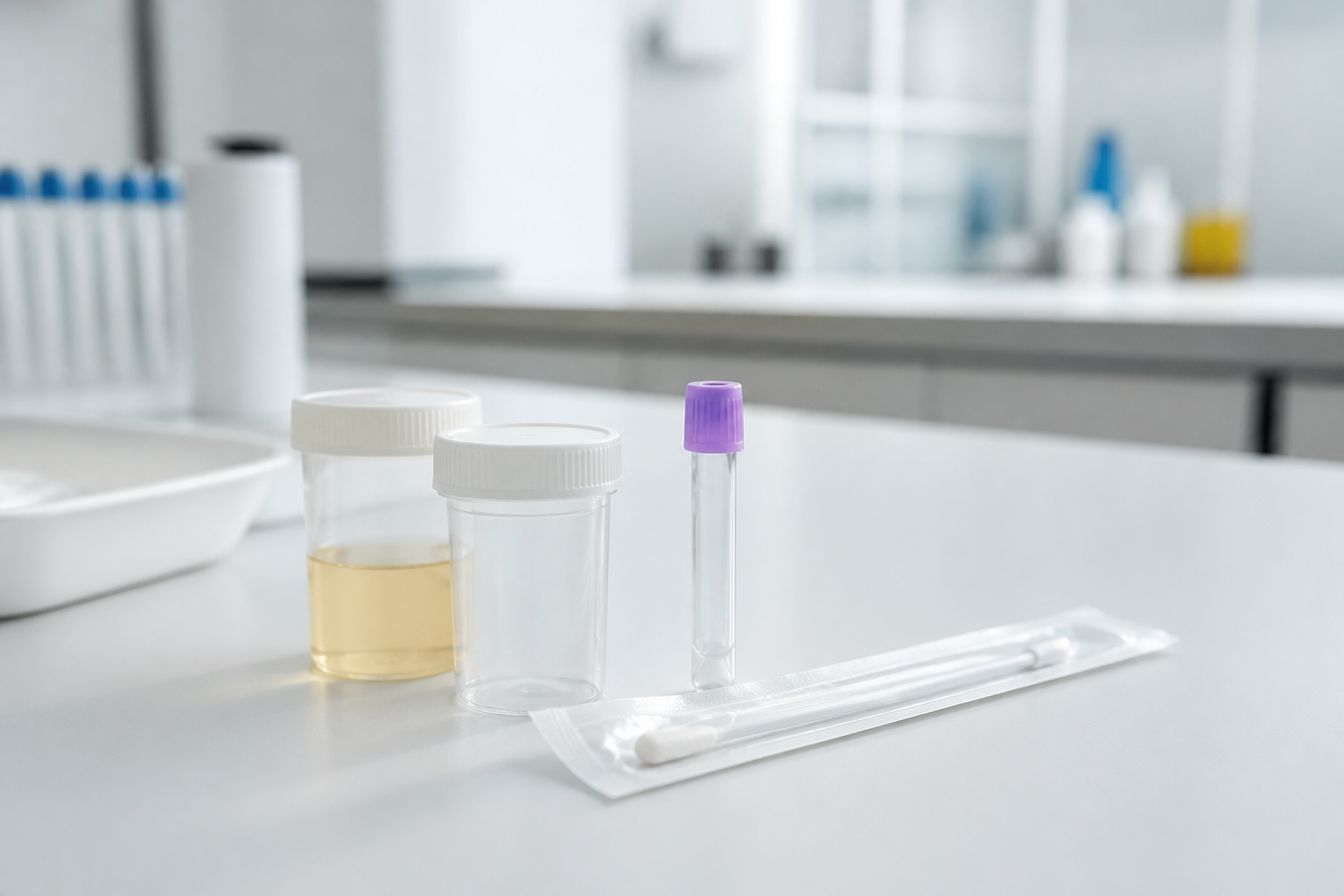
Rapid STD test accuracy depends on the infection, technology, specimen, testing site, and timing. Learn when rapid or laboratory testing may be appropriate.
Key takeaways
- Rapid does not automatically mean inaccurate, and laboratory testing is not automatically perfect.
- Accuracy varies by infection, technology, specimen, anatomic site, timing after exposure, and how the test is performed.
- Rapid molecular tests for chlamydia and gonorrhea can perform well, while some older non-molecular rapid tests have lower sensitivity.
- HIV self-tests use different methods and window periods from laboratory antigen-and-antibody tests.
- A reactive HIV or syphilis screening result generally needs additional interpretation or confirmatory testing.
Rapid STD test accuracy cannot be summarized with one number. The meaningful question is which infection is being tested, what technology is used, where the specimen comes from, how long it has been since exposure, and whether the test is performed at home, in a clinic, or by a laboratory. A rapid test may provide useful results quickly, but speed and accuracy are separate characteristics.
What does “accuracy” mean?
Sensitivity describes how often a test detects an infection when it is present. A test with lower sensitivity can produce false-negative results. Specificity describes how often a test is negative when the infection is absent. A test with lower specificity can produce false-positive results. Neither measure tells you exactly what an individual result means because interpretation also depends on timing, symptoms, exposure risk, the population tested, and the quality of the specimen.
An invalid result is different from a negative result. Invalid results can occur when user operation or specimen collection does not meet product requirements, or when the product instructions identify an invalid result. Product instructions should explain what to do after an invalid result. A negative result obtained during a window period may also fail to detect a recent infection.
Rapid testing is not one category
- Rapid molecular point-of-care tests detect genetic material from an organism. Some tests for chlamydia and gonorrhea can provide results during a clinical visit and have strong performance, but available specimen types and anatomic sites depend on the specific FDA-cleared test.
- Rapid antibody or antigen tests detect the immune response or components of an infection. Their window periods and performance differ from molecular tests.
- Self-tests are performed by the user and therefore depend on correct collection, operation, storage, timing, and interpretation. A self-test should not be treated as equivalent to every laboratory test.
- Laboratory NAATs detect genetic material and are identified by the CDC as the most sensitive recommended tests for chlamydia for commonly tested specimens.
- Laboratory serology measures antibodies or other blood markers. For syphilis, interpretation generally requires both nontreponemal and treponemal testing rather than relying on one result.
Chlamydia and gonorrhea: rapid molecular versus laboratory NAATs
For chlamydia, the CDC identifies nucleic acid amplification tests, or NAATs, as the most sensitive recommended tests for commonly tested specimens. The CDC also recognizes point-of-care NAAT options for chlamydia and gonorrhea. These tests can be clinically useful when receiving a result quickly may reduce delays in care or loss to follow-up.
A review of molecular point-of-care and near-point-of-care tests found strong analytical performance overall among current tests, while also noting limitations involving cost, turnaround time, and the limited range of FDA-cleared extragenital specimens. This means a rapid molecular test should be evaluated according to its own clearance, specimen instructions, and intended use—not as a representative of every rapid STD test.
Older rapid tests are not interchangeable with newer molecular tests. Systematic-review evidence found that some molecular point-of-care tests performed with high sensitivity and specificity, while several antigen or microscopy-based tests had substantially lower sensitivity despite high specificity. Therefore, “rapid” does not establish whether a test is reliable; the technology matters.
Why the collection site matters
The specimen must represent the site that may have been exposed. A genital specimen does not necessarily evaluate infection in the throat or rectum. The CDC supports patient-collected vaginal, rectal, and other specimens for certain FDA-cleared NAATs when appropriate, but the permitted specimen and site vary by product. If oral or anal exposure occurred, ask a qualified clinician or testing service which sites should be evaluated.
HIV: timing and test method are especially important
HIV tests have different window periods. The CDC states that laboratory antigen-and-antibody testing from venous blood usually detects HIV 18 to 45 days after exposure, while a nucleic acid test usually detects infection 10 to 33 days after exposure. Rapid antigen-and-antibody tests and antibody tests have different detection windows, so a negative result soon after exposure may not rule out infection.
FDA-labeled information for the OraQuick In-Home HIV Test reports approximately 92% sensitivity and 99.98% specificity in labeled clinical studies. Those figures apply to that product and its labeled use; they should not be generalized to all HIV self-tests or compared with laboratory testing without considering the different specimen, method, study design, and timing.
A reactive HIV self-test is a preliminary result, not by itself a confirmed diagnosis. It requires follow-up testing through a healthcare professional or testing service. The FDA-authorized INSTI HIV Self Test also has labeled instructions, user-operation requirements, invalid-result considerations, and performance information that should be followed exactly. A person concerned about a recent possible HIV exposure or acute symptoms should seek professional medical guidance rather than relying only on a consumer test.
Syphilis: a rapid result usually needs context
Syphilis testing illustrates why one rapid result may not answer the entire question. The CDC states that a presumptive diagnosis generally requires both nontreponemal and treponemal serologic testing. A rapid treponemal test can contribute information, but it is part of an interpretation process rather than a universal replacement for laboratory serology.
The CDC’s 2024 laboratory recommendations state that only limited point-of-care syphilis tests are available in the United States. Rapid testing can shorten the time to results, but dual serologic approaches and careful interpretation remain important. A reactive result may require additional testing, and a negative result may be affected by the stage of infection and timing.
When laboratory testing may be the better choice
- The possible exposure was recent and may fall within a test’s window period.
- You have symptoms, a known exposure, or a clinical concern that requires evaluation.
- The throat or rectum was exposed and the available rapid test does not include the relevant site.
- You need HIV testing with a laboratory antigen-and-antibody method or a clinician-directed testing plan.
- A rapid result is reactive, invalid, or inconsistent with symptoms or exposure history.
- You are pregnant and need guidance from a qualified healthcare professional or public-health clinic.
- You are concerned about sexual assault and need evaluation from a qualified healthcare professional or public-health clinic.
- You are worried about possible acute HIV.
Laboratory testing is not automatically perfect, and a laboratory result can also be affected by timing and specimen quality. However, laboratory methods may use a different technology or testing algorithm than a rapid self-test. The appropriate option depends on the medical question, not simply on how quickly results are available.
How to compare a rapid test with a lab test
- Identify the infection and technology: molecular, antigen, antibody, or combined antigen-and-antibody.
- Check the labeled specimen and collection site, including whether throat or rectal testing is supported.
- Consider the time since exposure and the test’s stated window period.
- Read instructions carefully and understand how invalid, reactive, and negative results are defined.
- Confirm whether a reactive screening result requires supplemental or confirmatory testing.
- Use medical care rather than a consumer test alone when symptoms, pregnancy, a known exposure, suspected sexual assault, or concern about acute HIV is involved.
Bottom line
The most accurate answer to “Are rapid STD tests as accurate as lab tests?” is that it depends. Some rapid molecular tests can perform well, while some non-molecular rapid tests have important sensitivity limitations. HIV self-tests require particular attention to window periods and follow-up after a reactive result. Syphilis testing generally requires interpretation using more than one serologic approach. Choose testing based on the infection, method, timing, specimen, and exposure site, and seek professional care when a rapid result is concerning or the situation is medically urgent.
Frequently asked questions
Are rapid STD tests accurate?
Some rapid tests are accurate, but performance varies substantially by infection, technology, specimen, site, timing, and instructions. Rapid molecular tests may perform well, while some older non-molecular tests have lower sensitivity.
Are rapid STD tests less accurate than laboratory tests?
Not necessarily. Rapid and laboratory tests use different technologies, and neither category is uniform. The specific assay, specimen, site, timing, and intended use determine performance.
Can a negative rapid STD test rule out infection?
No. A negative result may not rule out a recent infection during the window period, and a genital specimen may not evaluate an exposed throat or rectal site.
How accurate are HIV home tests?
Performance depends on the product and timing. FDA-labeled information for the OraQuick In-Home HIV Test reports approximately 92% sensitivity and 99.98% specificity in labeled clinical studies. These figures should not be generalized to every HIV self-test.
Does a reactive rapid HIV test confirm HIV?
No. A reactive self-test is a preliminary result that requires follow-up testing through a healthcare professional or testing service.
Can a rapid syphilis test diagnose syphilis by itself?
Generally, no. CDC guidance indicates that syphilis diagnosis usually requires interpretation of both nontreponemal and treponemal serologic testing.
Sources & references
- Chlamydial Infections: STI Treatment Guidelines
- Gonococcal Infections Among Adolescents and Adults: STI Treatment Guidelines
- Syphilis: STI Treatment Guidelines
- CDC Laboratory Recommendations for Syphilis Testing, United States, 2024
- How Do I Know If I Have HIV?
- Information regarding the OraQuick In-Home HIV Test
- INSTI HIV Self Test
- Point-of-care Tests for Chlamydia trachomatis and Neisseria gonorrhoeae: Review of the Literature
- A Systematic Review of Point of Care Testing for Chlamydia trachomatis, Neisseria gonorrhoeae, and Trichomonas vaginalis
- Screening for Chlamydia and Gonorrhea: USPSTF Recommendation
- A and B Recommendations: HIV Screening
Sources are provided for general educational purposes only. This article is not medical advice. Consult a qualified healthcare professional with any health concerns.
Ready to compare testing options?
Use our independent, educational comparisons to understand your online STD/STI testing options.
View Provider Testing OptionsAffiliate link — we may earn a commission if you choose a provider through this link, at no extra cost to you. Pricing, turnaround and availability are set by the provider and can change.